

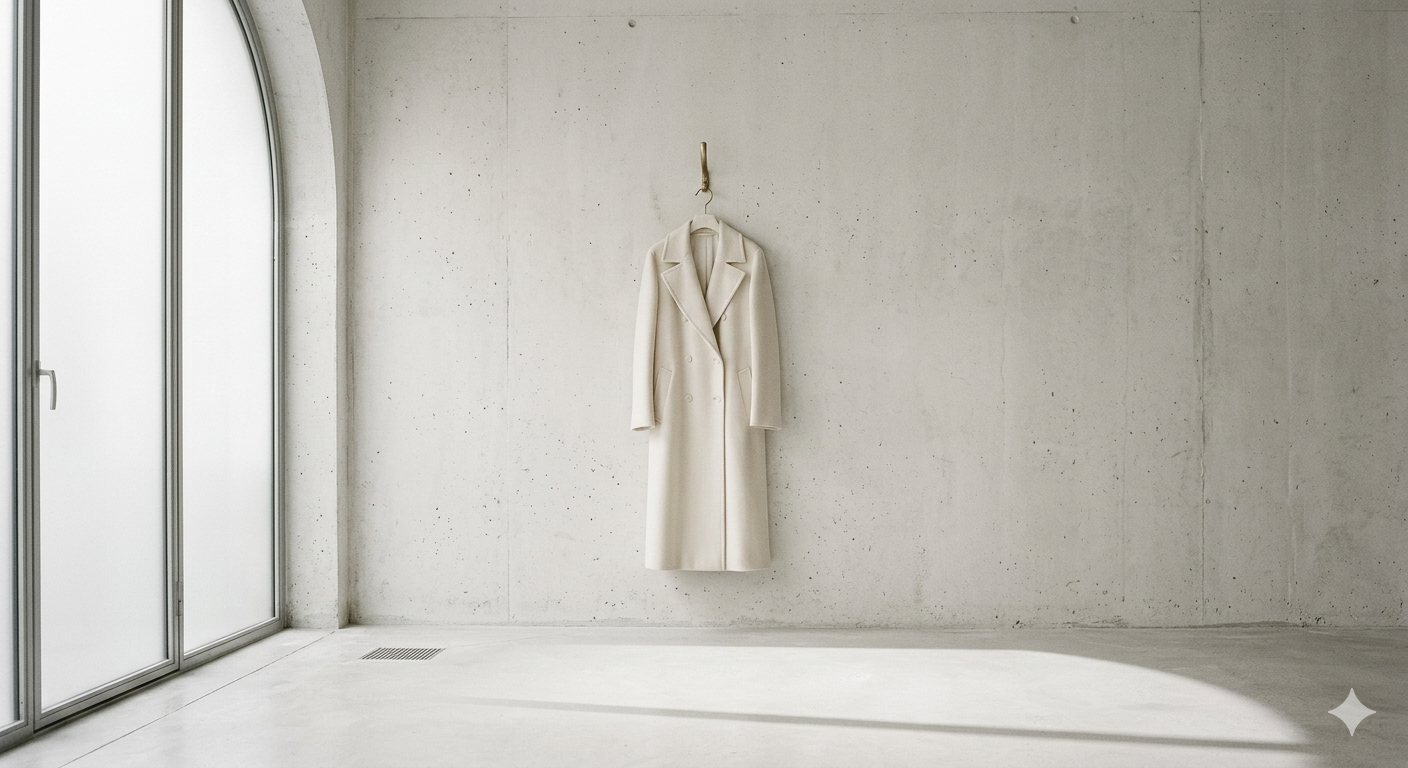
Quiet luxury became the defining fashion conversation of the past three years. In Monaco, it was never a trend — it was already the norm. Here's what it actually means in practice, and which brands genuinely embody it.
A trend that arrived late to Monaco
In 2023, "quiet luxury" became the dominant fashion conversation globally — accelerated by the HBO series Succession, whose costume designer Michelle Matland dressed the Roy family in a coherent visual language of unmarked cashmere, precise tailoring, and the conspicuous absence of logos. The fashion press treated this as a revelation. In Monaco, it landed as a description of something that had been the prevailing aesthetic for at least a decade.
The Monaco resident community — multi-generational European wealth, billionaire executives, heads of sovereign funds, and royal family members — has never been a logo-wearing culture. Not because logos are considered tasteless in the abstract, but because in a community where everyone knows exactly who everyone is and what they own, a logo communicates nothing. The work is done by cut, fabric, and fit. This is quiet luxury not as a trend but as a structural consequence of the social environment.
What quiet luxury actually means — and doesn't mean
The term is sometimes misread as minimalism, or as a preference for neutral colours, or as anti-fashion. None of these is accurate. Quiet luxury is a relationship between garment and body that prioritises material quality and construction precision over surface decoration. A Valentino gown in a deeply saturated pink, with no visible logo, from exceptional fabric, cut by extraordinary hands, is quiet luxury. A beige shirt from a fast-fashion brand is not, regardless of how unmarked it is.
The markers that communicate quality in this register are invisible to an uneducated eye and immediately legible to an informed one. The break of a jacket sleeve. The drape of a cashmere that falls from the shoulder without creating bulk. The way Loro Piana's Baby Cashmere — sourced from Hircus goats in Inner Mongolia, one of the rarest natural fibres in the world — handles compared to a standard cashmere. These distinctions are real, they are significant, and they are the actual content of quiet luxury.
The brands that genuinely embody the aesthetic
Loro Piana is the apex of the category. Founded in Quarona in the Piedmont in 1924, the house built its reputation on raw material sourcing before most luxury brands understood what that meant. Their Storm System ® waterproofing, their vicuna pieces (one of the most expensive natural fibres in the world), their Baby Cashmere — these are not marketing constructs. They represent genuine technical achievement in textile manufacturing. Acquired by LVMH in 2013, the house has retained its operational independence and its focus on material over image.
Brunello Cucinelli occupies a related but distinct position. Based in Solomeo, Umbria — a medieval hamlet the founder has restored entirely as a manifestation of his humanist philosophy — the brand produces knitwear and tailoring of exceptional quality at prices that reflect the labour involved. The aesthetic is warm, slightly rural in its Italian interpretation, and deeply consistent. Cucinelli has written and spoken extensively about the relationship between quality production and human dignity; whether or not you share the philosophy, the products are consistently excellent.
The Row, founded by Mary-Kate and Ashley Olsen in 2006 and developed into one of the most respected luxury brands in the world, operates in a more contemporary register. The construction standards are couture-adjacent — pieces are made in Italy and France using factories that work for the major houses. The silhouettes are architectural and spare. The Row has almost no marketing presence in the conventional sense, which has paradoxically made it the most discussed label in informed fashion circles for the past five years.
Kiton, the Neapolitan tailoring house founded in 1956, produces what many consider the finest ready-to-wear suits in the world. Each suit requires approximately 25 hours of handwork. The company employs a significant number of sartori — tailors trained in the Neapolitan tradition — in a workshop in Arzano, outside Naples. A Kiton suit is not a logo purchase. It is a construction purchase, and the construction is immediately apparent to any eye trained to see it.
What quiet luxury is not
A common misapplication: buying beige things. Colour has nothing to do with this aesthetic. A strong cobalt cashmere from Loro Piana is quiet luxury. A beige synthetic blazer is not. The confusion comes from conflating palette with principle. The principle is material authenticity and construction precision — colour is irrelevant.
A second misapplication: assuming any brand without a prominent logo qualifies. Several brands have positioned themselves as quiet luxury while producing at price points and quality levels that don't sustain the claim. The test is not the absence of a logo. It is what remains when the logo is removed.
If you're building a wardrobe in this register — or refining one that's already moving in this direction — discover my Personal Shopping & Wardrobe Exclusive service.



%20(1).webp)