

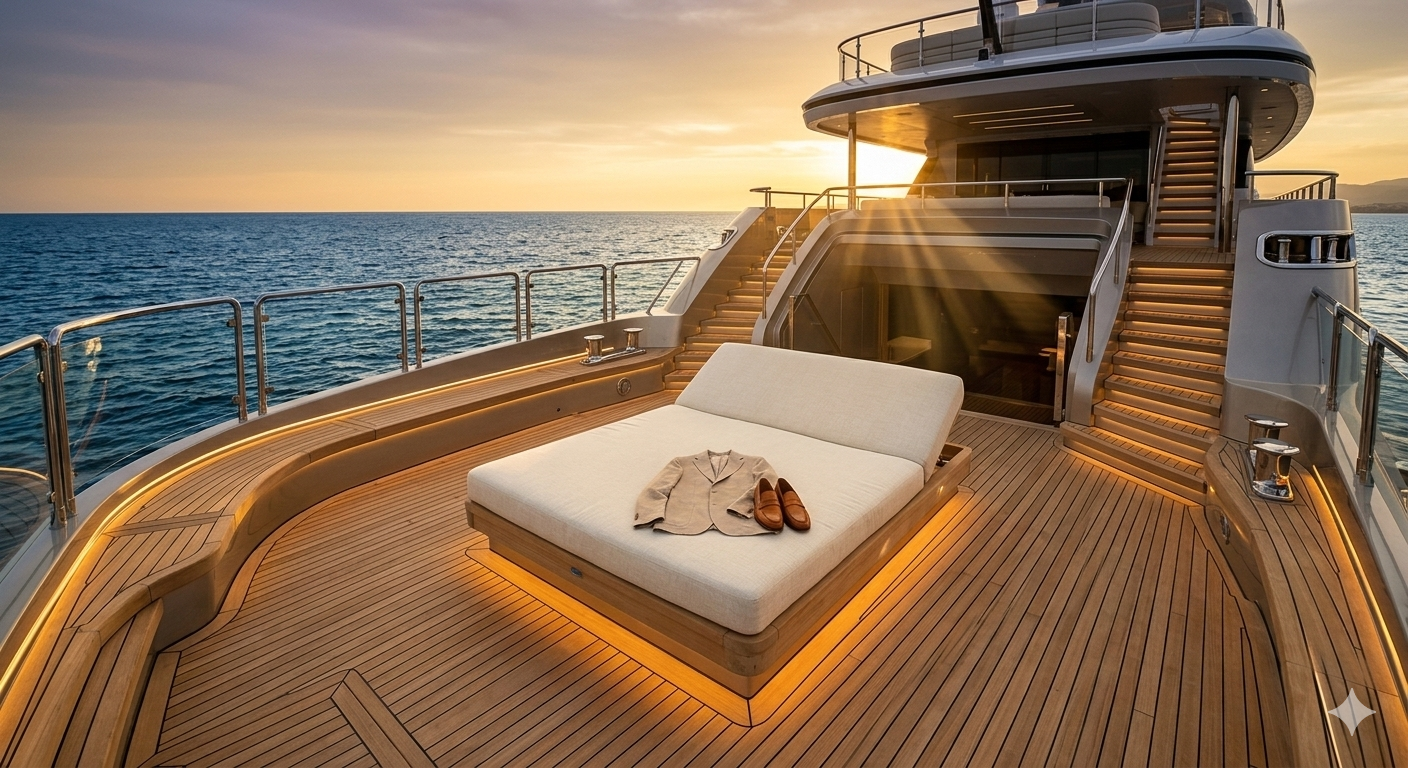
Superyacht dressing has its own unwritten codes — and they shift depending on whether you're a guest, an owner, or somewhere in between. Here's how it actually works, from someone who boards these boats regularly.
The code that doesn't exist in writing
There is no official superyacht dress code. No laminated card in the cabin, no section in the invitation. Yet anyone who spends time around serious yachting in Monaco, Sardinia, or the Greek islands knows immediately when someone has got it wrong — the guest who arrives in a linen suit to a casual swim day, the first-timer who shows up to a formal deck dinner in shorts. The code is real. It's simply transmitted through proximity rather than protocol.
What follows is that code, decoded by context.
The swim day: the most misread context
A casual day onboard — swimming, lunching, moving between anchorages — is the context where guests most often over- or under-dress. The key principle: quality, not formality. Swimwear should be from a serious brand — Eres, Vilebrequin (the trunks that have been on Mediterranean yachts since 1971), Orlebar Brown for men, or Heidi Klein for women's resort. These are not arbitrary choices — at this level, the construction, the fabric weight, and the cut are all immediately legible to an experienced eye.
Cover-ups matter. A sarong from a market versus a Missoni or Pucci kaftan versus a Loro Piana linen shirt — these are different statements made in a context where people have very little to read other than what you're wearing. Footwear on deck: no shoes with hard soles that could mark the teak. Quality deck shoes or bare feet. Sebago remains the practical reference; Aquazzura and Ancient Greek Sandals work for women who want something more considered.
The cocktail hour: the pivot moment
The hour before dinner — typically spent on the main deck or aft deck as the sun drops — is where the register shifts. A swimsuit is no longer appropriate. For women: a lightweight dress or silk co-ord, a linen trouser with a blouse. The transition should feel effortless rather than costumed. For men: linen trousers or chino shorts (not beach shorts) with a well-cut short-sleeved shirt or a light linen button-down. Nothing branded across the chest. The vocabulary is the same as an elevated terrace at a coastal hotel — because that's essentially what the deck becomes at this hour.
Formal dinner on deck or in the main saloon
When a dinner is described as formal — and on privately owned yachts entertaining significant guests, formal dinners are common — the standard approaches a restaurant in Monte-Carlo rather than a relaxed holiday supper. For women: a midi or maxi dress in a quality fabric, or trousers and a considered top. Heels are viable on a stable vessel at anchor; flats or block heels on a moving one. For men: a blazer is not excessive. On a Lurssen or Feadship with a formal dining room, a jacket is genuinely appropriate.
The owner's context vs the guest context
There is a subtle but real distinction between how an owner dresses on their own vessel and how a guest dresses onboard someone else's. Owners can be more relaxed — it is their home, after all, and the ease of that shows. Guests are well-served by being slightly more considered. Not more formal necessarily — more deliberate. It signals awareness of the context and respect for the host without tipping into stiff formality that would feel odd at sea.
If you're preparing a wardrobe for the yachting season — whether as an owner or a frequent guest — discover my Personal Shopping & Wardrobe Exclusive service.



%20(1).webp)