


Styling a superyacht interior is one of the most technically demanding disciplines in luxury design. Here's what the process actually involves — and why the Monaco standard has a precise meaning.
What the Monaco standard actually means
In professional yachting circles, the "Monaco standard" refers to a level of finish and coherence set by the vessels that appear at the Monaco Yacht Show each September and circulate through Port Hercule during the summer season. These are not simply expensive boats. They are floating environments designed by specialist studios — Winch Design, Reymond Langton, Sinot Yacht Architecture & Design — who approach life onboard with the same rigour the best architects bring to residential projects. A vessel based in Monaco is seen daily by a highly informed audience. Working below this standard is conspicuous.
The fundamental rule: everything must be securable at sea
This is what changes everything in yacht interior styling, and what I explain first to clients approaching nautical interiors for the first time. Every decorative object, every piece of furniture, every artwork must be securable — or removable — when the vessel is underway. Objects that look magnificent in a Monaco apartment become projectiles in a Force 8 in the Bay of Biscay. The best yacht designers work within these constraints with such fluency that the solutions become invisible: built-in shelving with lips, furniture with concealed magnetic fixings, artworks on vibration-absorbing systems. The interior reads as pure elegance, not an engineering compromise.
Materials: what works and what fails
Leathers: Standard leather degrades quickly in a marine environment. The specialist alternative is marine leather — Boxmark (Austria) produces some of the finest in the sector — engineered to resist moisture, salt and UV while retaining the hand of premium upholstery.
Textiles: On exterior deck areas, Sunbrella remains the industry standard. For interiors, textiles must be tested for colour stability under strong Mediterranean light — what appears rich in a London showroom can look washed out after a single summer at sea.
Timber: Teak remains the standard for decking — warm underfoot, non-slip when wet, visually consistent with the yachting vocabulary. For interior joinery, I work primarily with European walnut and sipo mahogany — two species that remain stable across variable humidity conditions.
Stone: Beautiful but heavy. On larger superyachts, stone flooring and worktops are achievable if the naval architect has accounted for the weight. On smaller vessels, high-quality porcelain or resin alternatives genuinely merit consideration.
The interior-wardrobe connection
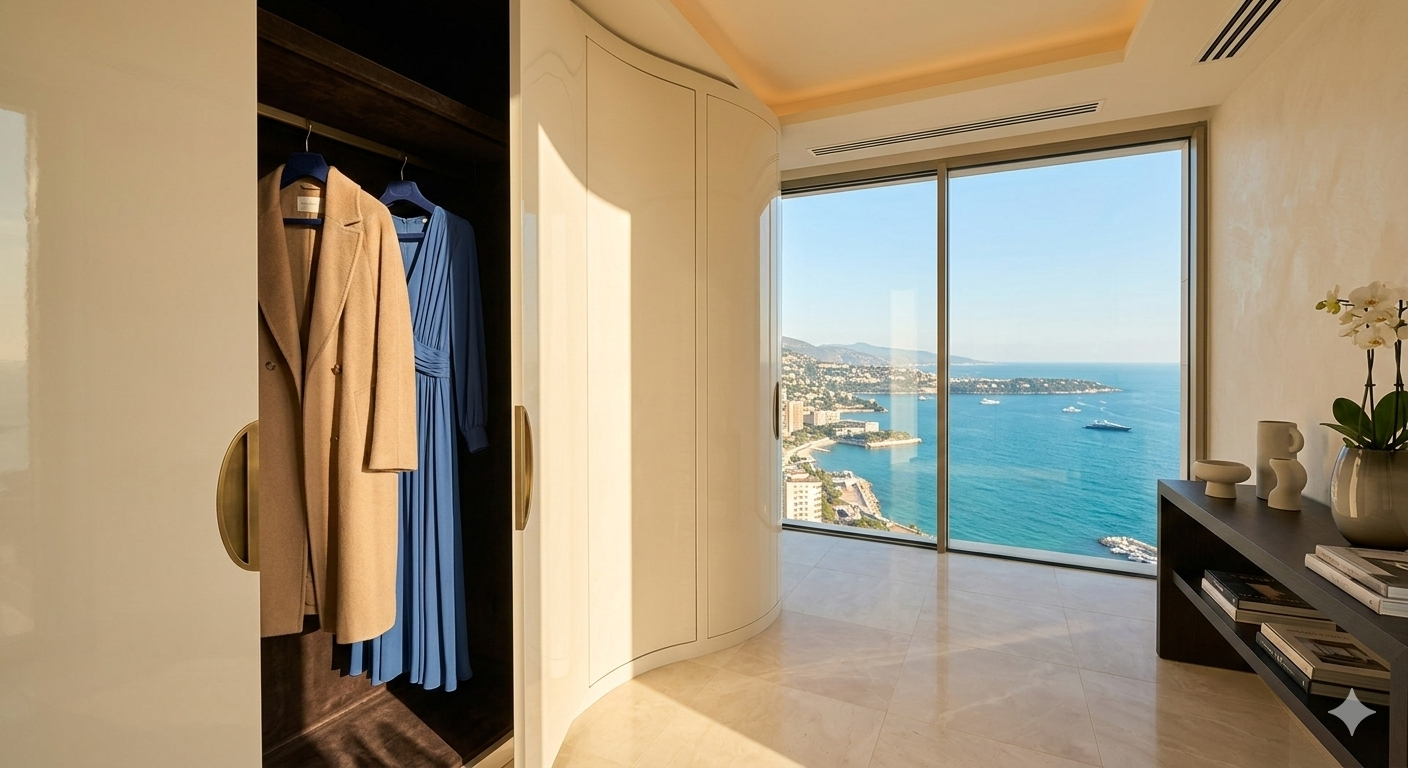
The most coherent onboard experiences are those where the vessel's interior aesthetic and the owner's wardrobe share a visual language. A boat with a warm, natural interior — aged oak, linen, stone — calls for a wardrobe in the same register: earthy tones, natural fibres, quiet luxury. Working across both yacht styling and personal wardrobe allows me to create this coherence deliberately, rather than leaving it to chance.
Discover my Tailored Yacht Styling service — and let's discuss what your vessel could become before the next Mediterranean season.




%20(1).webp)